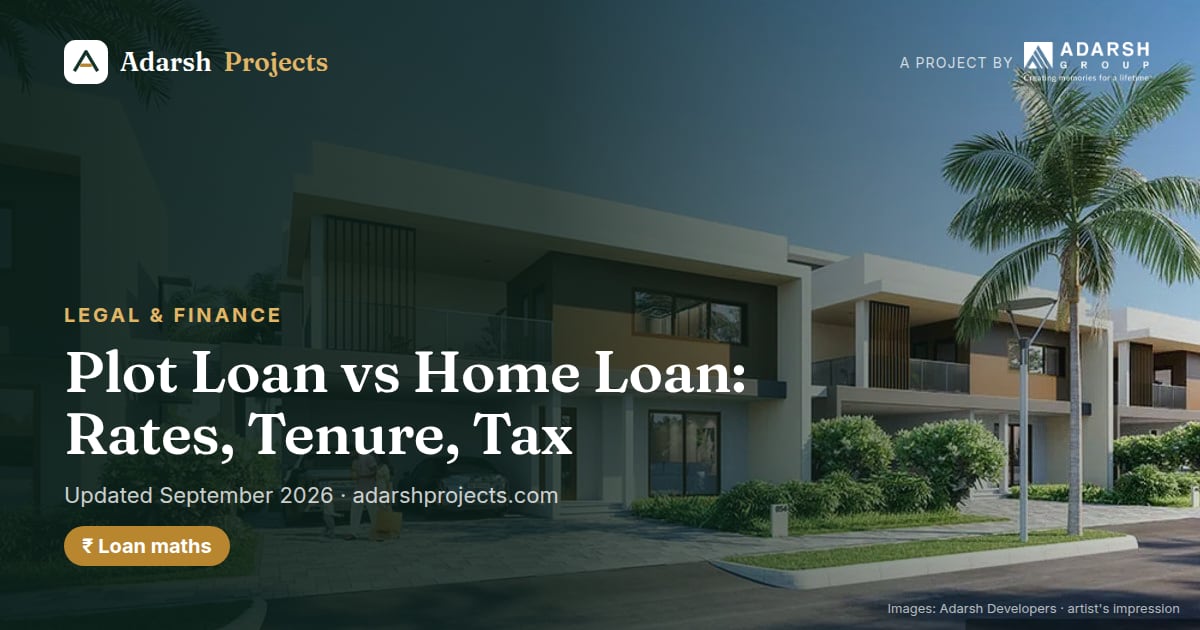
In the plot loan vs home loan choice, a plot loan pays for land only. It usually covers less of the price, runs for a shorter term and gives no tax benefit until you build. A home loan covers a house or flat, runs longer and offers tax breaks.
This guide compares both on rates, loan amount, tenure and tax. It draws on RBI data, Income Tax Department pages and Business Standard reports. Rates change often, so confirm with the bank before you apply.
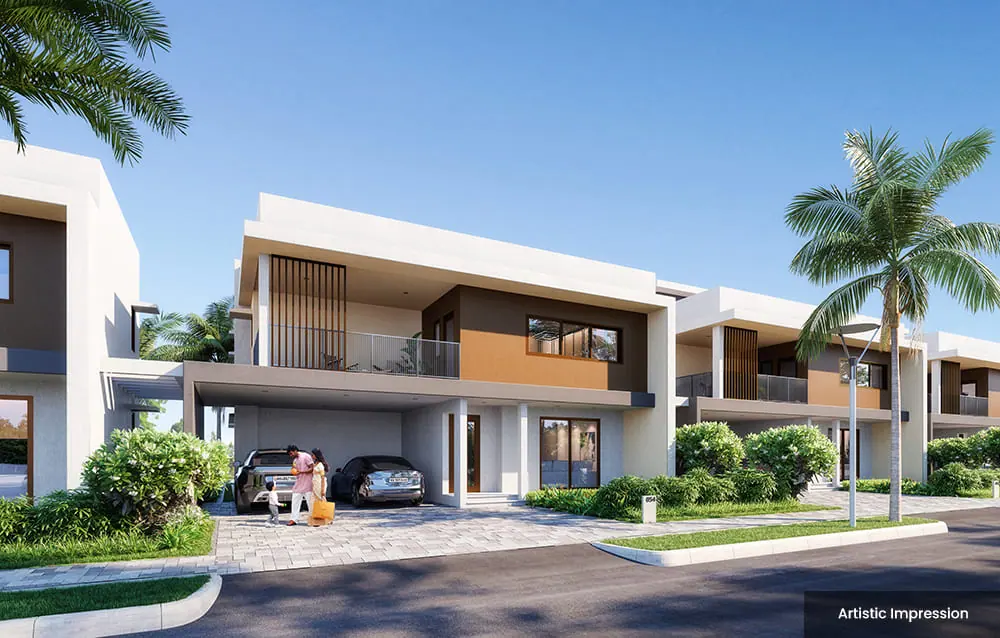
We use a plotted layout, Adarsh Savana Phase 3, as the running example.
This is general information, not financial, legal or tax advice. Speak to your bank and a tax adviser before you decide.
Plot Loan vs Home Loan at a Glance
| Point | Plot loan | Home loan |
|---|---|---|
| What it funds | Residential land only | Ready or under-construction home |
| Loan-to-value (LTV) | Often 60%–75% of value; set by each bank | RBI caps: 90% up to ₹30 lakh, 80% up to ₹75 lakh, 75% above |
| Tenure | Often 5–15 years | Up to 30 years |
| Interest rate | Bank card rate; ask your branch | About 7% to 13.52% across lenders* |
| Tax on principal | None until house is built | Section 80C (Section 123 in the new Act), old regime |
| Tax on interest | None until house is built | Section 24(b), old regime |
| Use of land | Must be residential, in an approved layout | Must have approved plans |
*Home loan rates as of 26 August 2026, as reported by Business Standard. Plot loan bands are from a Business Standard guide. Your rate depends on your credit score, income and loan size.
What Is a Plot Loan?
A plot loan helps you buy a residential site. You use it to pay the seller or developer for the land. You do not need to start building right away with a pure plot loan.
Banks see land as riskier than a house. A house earns rent and is easy to value. Land may sit empty for years. That is why plot loans come with tighter terms.
Most banks fund only plots that meet these rules:
- The land is for residential use.
- The plot sits in an approved layout.
- The land has a conversion order from farm use.
- The title is clean and the seller can prove it.
- The plot has a clear khata or local body record.
Plot loans are for residential land, not farm land. For the paper checks, see our list of 14 documents to check before buying a plot.
What Is a Home Loan?
A home loan helps you buy a ready home, an under-construction flat, or build a house. It can also fund an extension or a repair at many banks.
Some banks fold plot purchase into their home loan product. The terms for land may still differ. Ask the bank which rules apply to your case.
Interest Rates: What Banks Charge in 2026
Most home loans in India now link to an outside benchmark. For many banks, that benchmark is the RBI repo rate. The repo rate is the rate at which the RBI lends to banks.
The RBI website listed the policy repo rate at 5.25% as at 15 September 2026. When the repo rate moves, linked loan rates move too.
Home Loan Rates Reported in August 2026
| Lender | Home loan rate |
|---|---|
| SBI | 7.25% to 9.05% |
| HDFC Bank | From 7.75% |
| Bank of Baroda | 7.20% to 9.25% |
| Lowest start rate in the report | 7% |
| Highest rate in the report | About 13.52% |
*Business Standard, 27 August 2026, with rates as of 26 August 2026. Starting rates go to borrowers with top credit scores.
A few notes on this table:
- The report covers home loans only. Ask each bank for its plot loan card rate.
- Your rate depends on your credit score, income, job type and loan size.
- Test any quote against a real budget, such as the Adarsh Savana Phase 3 price details.
Why Plot Loans Can Cost More
Plot loan buyers may pay more than home loan buyers. Banks price risk. Land is harder to sell after a default, and the loan runs for a shorter term. Ask for your actual rate in writing.
Loan-to-Value: How Much the Bank Will Fund
LTV means loan-to-value. It is the share of the property cost that the bank pays. You pay the rest as your down payment.
Home Loan LTV
RBI sets caps on how much banks can lend for a home. Business Standard reported them like this:
| Loan amount | Maximum LTV |
|---|---|
| Up to ₹30 lakh | 90% |
| ₹30 lakh to ₹75 lakh | 80% |
| Above ₹75 lakh | 75% |
Plot Loan LTV
Banks set their own plot loan limits. A Business Standard guide puts plot funding at 60% to 75% of the value. Home loans can go higher, within the RBI caps above.
Ask whether your bank funds less for plots outside city limits. Many plotted layouts, such as those around Devanahalli, sit outside the GBA area. Check this before you plan your down payment.
What LTV Means for Your Down Payment
Say you buy a plot priced at ₹80 lakh.
- At 75% LTV, the bank lends ₹60 lakh. You pay ₹20 lakh.
- At 60% LTV, the bank lends ₹48 lakh. You pay ₹32 lakh.
On top of this, plan for stamp duty, registration and legal fees. Banks often leave these out of the cost they fund. Ask your bank how it treats them.
Tenure: How Long You Can Repay
Tenure is the time you get to repay the loan.
- Plot loans: often 5 to 15 years, per a Business Standard guide.
- Home loans: up to 30 years, per the same guide.
- Moratorium: some banks offer a period when you pay only interest, or nothing, while the house gets built. Ask your bank.
How Tenure Changes Your EMI
A shorter term means a higher monthly payment but less total interest. Here is an example for a ₹60 lakh loan. These are our own maths, not bank quotes.
| Loan | Rate | Term | Monthly EMI | Total interest |
|---|---|---|---|---|
| ₹60 lakh | 7.75% | 15 years | about ₹56,500 | about ₹41.7 lakh |
| ₹60 lakh | 8.75% | 15 years | about ₹60,000 | about ₹47.9 lakh |
| ₹60 lakh | 7.75% | 30 years | about ₹43,000 | about ₹94.7 lakh |
The 15-year plot loan term pushes the EMI up. Check that your monthly income can carry it. Many banks cap your total EMIs at a share of your income. Then line up the EMI with the Adarsh Savana Phase 3 payment plan.
Tax Benefits: The Biggest Gap
This is where plot loan vs home loan differ the most.
Pure Plot Loan: No Tax Break
The tax deductions for home loans apply to a residential house. Land alone is not a house. Business Standard's guide notes that a plot loan earns a tax benefit only after the house is complete.
Home Loan: Two Main Deductions
Under the old tax regime, you can claim:
- Principal: up to ₹1.5 lakh a year under Section 80C. This limit also covers PPF, ELSS, life cover and similar items.
- Interest: up to ₹2 lakh a year under Section 24(b), for a home you live in, per the Income Tax Department.
For a let-out home, the interest rules differ. Ask your tax adviser.
The New Income-tax Act, 2025
A new Income-tax Act applies from 1 April 2026. It renumbers many sections. Business Standard reported this change:
| Item | 1961 Act | 2025 Act |
|---|---|---|
| Principal and other savings, up to ₹1.5 lakh | Section 80C | Section 123 |
| Interest on a house property loan | Section 24(b) | Check the final text |
The report said the ₹1.5 lakh cap stays the same. Check the final text on the Income Tax Department site or with your adviser.
New Regime vs Old Regime
The Income Tax Department lists the new regime as the default. It drops most deductions. Under it, you cannot claim the Section 80C deduction or interest on a self-occupied home.
If your plan depends on home loan tax breaks, compare both regimes each year.
When a Plot Loan Starts to Save Tax
Once you build a house on the plot, the picture changes. The Income Tax Department describes these rules:
- The ₹2 lakh interest cap applies if you finish the house within five years from the end of the year you borrowed.
- Interest paid before completion is pre-construction interest. You claim it in five yearly parts, starting in the year the house is finished.
- If you miss the five-year limit, the interest cap drops to ₹30,000 a year.
Ask a chartered accountant how this applies to the land part of your loan. If tax breaks matter more to you than land, read our plot vs apartment comparison.
Composite Loans: Plot Plus Construction
A composite loan funds both the plot and the house. The bank pays for the land first. It then releases the rest in stages as you build.
How It Works
- The bank approves one total loan for land and building.
- It pays the seller for the plot.
- You get your building plan approved.
- The bank releases money at each stage, such as foundation, walls and roof.
- You pay interest only on the money released so far.
Time Limits
Composite loans come with a deadline to build. Business Standard's guide says banks use the local authority's time frame or their own, whichever is earlier. Ask for the deadline in writing.
Pros and Cons of a Composite Loan
Pros:
- One loan, one bank, one set of papers
- Tax benefits start once the house is ready
- Stage-wise release keeps interest low in the early months
Cons:
- You must build within the bank's deadline
- Build costs can overrun the loan
- Delays can hurt your tax claim and your budget
- You need an approved building plan before stage payments start
If you do not plan to build within three to five years, a composite loan may not suit you. The bank will also check the conversion order and layout approval before it pays for the land.
Which Loan Should You Choose?
The answer depends on your plan for the land.
| Your plan | Better fit |
|---|---|
| Buy a plot now, build in 1–3 years | Composite loan |
| Buy a plot as a long-term investment | Plot loan, or pay in cash |
| Buy a ready or under-construction flat | Home loan |
| Want the lowest EMI | Home loan (longer term) |
| Want tax breaks right away | Home loan |
Honest Downsides of Plot Loans
- Higher down payment than a home loan.
- Shorter term, so higher EMI.
- No tax saving while the land is empty.
- Tighter rules on layout approval and location.
- Some banks may fund less for plots outside city limits.
Honest Downsides of Home Loans for Flats
- A 30-year term means you pay far more total interest than the tax you save.
- Under-construction flats carry delay risk.
- A flat has no land of its own. You share an undivided share of the land.
Our plot vs apartment guide looks at the wider trade-off beyond loans.
Plot Loan or Cash? A Simple Test
Some buyers pay cash for land and borrow later to build. Others take a loan from day one. Ask yourself four questions.
- Do you have the full price in savings? If yes, a loan only adds cost while the land sits empty.
- Would the cash earn more elsewhere? Compare the loan rate with what your savings earn after tax.
- Do you need an emergency fund? Never drain it to avoid a loan.
- When will you build? If soon, a composite loan may give you tax benefits sooner.
There is no single right answer. Write down your numbers and compare the total cost over five years.
Can You Switch Lenders Later?
Many banks let you move a home loan to another lender. This is a balance transfer.
Some buyers ask whether a plot loan can move the same way. Rules differ by bank, and some lenders treat land loans with more caution. Ask your new lender before you count on a switch.
Keep an eye on the repo rate too. A floating loan moves when the RBI changes the rate. The RBI's next policy dates appear on its website.
Documents Banks Ask For
Most banks ask for two sets of papers.
About you:
- PAN and Aadhaar
- Salary slips or business accounts
- Bank statements
- Income tax returns
About the plot:
- Sale deed or agreement for sale
- Title chain and encumbrance certificate
- Conversion order and layout approval
- Khata or e-khata and tax receipts
- K-RERA registration, for a new layout
A B khata or unapproved layout can block your loan. Our A khata vs B khata guide explains why.
Tips Before You Apply
- Check your credit score. It drives your rate.
- Get quotes from at least three lenders.
- Ask for the full cost: rate, processing fee and legal fee.
- Ask whether the developer's project has pre-approval from your bank.
- Get the in-principle approval before you pay a large token.
Financing a Plot in a New Layout
If you are buying in a new plotted development, ask the sales team which banks have approved the project. Pre-approval can speed up your loan, but you still need your own legal check.
Adarsh Savana Phase 3 is a plotted development in Devanahalli. See its payment plan and its price details to estimate your down payment. For the local market, read our Devanahalli property investment guide.
You can browse more options on our plots in Bangalore page. When you are ready, book a site visit and bring your loan questions.
Sources
- Reserve Bank of India — policy repo rate (5.25% as at 15 September 2026)
- Business Standard — Home loan rates start at 7% in August (SBI 7.25–9.05%, HDFC Bank from 7.75%, Bank of Baroda 7.20–9.25%; range up to 13.52%), 27 August 2026
- Business Standard — RBI LTV caps: 90% up to ₹30 lakh, 80% up to ₹75 lakh, 75% above (9 October 2015)
- Business Standard — Guide to plot loans: 60–75% funding, 5–15 year terms, tax benefit only after construction (July 2015)
- Business Standard — Section 80C deductions move to Section 123 from 1 April 2026, ₹1.5 lakh cap unchanged
- Income Tax Department — Self-occupied house property: ₹2 lakh / ₹30,000 interest limits, pre-construction interest in 5 instalments
- Income Tax Department — FAQs on new vs old tax regime (default regime, deductions not allowed)
- Income Tax Department
Frequently asked questions
What is the difference between a plot loan and a home loan?
A plot loan pays for land only. A home loan pays for a built or under-construction house or flat. Plot loans usually have lower loan amounts, shorter terms and no tax benefit until you build.
What is the maximum tenure for a plot loan?
It depends on the bank. A Business Standard guide puts plot loan terms at 5 to 15 years, against up to 30 years for home loans. Ask your bank for its current limit.
Do I get tax benefits on a plot loan?
Not on a pure plot loan. The principal and interest deductions apply to a residential house. Once you build and finish the house, you can claim them under the old tax regime, within the set limits.
How much loan can I get on a plot?
A Business Standard guide puts plot funding at 60% to 75% of the value. Each bank sets its own limit, so ask for it in writing. Plan the rest as your down payment.
What is a composite loan?
A composite loan funds both the plot and the house you build on it. The bank pays for the land first, then releases the rest in stages as you build. Each bank sets a deadline to finish the house, so ask for it in writing.
Can I get a plot loan on a B khata or farm plot?
Most banks lend only on plots with clear title, a conversion order and an approved layout. B khata and farm plots are hard to fund. Get the bank's written approval before you pay a token.
Adarsh Projects Research Desk
Channel-partner research team · Last reviewed 15 Sept 2026
We track K-RERA filings, price sheets and site progress for every Adarsh project in Bengaluru.
This guide is general information, not legal, tax or investment advice. Prices marked * are indicative as of September 2026.