Before buying a plot in Bangalore, check the title deed, mother deed, EC, RTC, conversion order, layout plan, khata and K-RERA record. These are the core documents to check before buying a plot. This guide lists all 14, where to get each one, and the red flags to watch.
Most plot frauds in Bengaluru follow a few patterns. A seller sells the same site twice. A layout has no approval.
Some sellers pass off farm land as a housing site. Each of the 14 checks below closes one of those gaps. You can run them on any layout, including Adarsh Savana Phase 3 in Devanahalli.
This is general information, not legal advice. Rules change often. Hire a property lawyer to read your documents before you pay.
The 14 Documents at a Glance
| # | Document | What it proves | Where to get it |
|---|---|---|---|
| 1 | Title deed (sale deed) | Seller owns the plot | Seller; Kaveri 2.0 for a certified copy |
| 2 | Mother deed and title chain | Past owners were genuine | Seller; sub-registrar office |
| 3 | Encumbrance certificate (EC) | No loans or other claims | Kaveri 2.0 |
| 4 | RTC (pahani) | Land record for the survey number | Bhoomi portal |
| 5 | Mutation register (MR) | How ownership changed in land records | Bhoomi portal; taluk office |
| 6 | Land conversion order | Land is cleared for non-farm use | Land conversion portal; DC office |
| 7 | Layout approval | Planning body approved the layout | BDA, BMRDA, BIAAPA or local planning body |
| 8 | Khata or e-khata | City or panchayat record and tax status | e-Aasthi or e-Swathu |
| 9 | Property tax receipts | No tax dues | Seller; city or panchayat portal |
| 10 | K-RERA registration | Project follows RERA rules | rera.karnataka.gov.in |
| 11 | Survey sketch | Plot boundaries match the land | Survey office; Bhoomi services |
| 12 | Road and park handover deed | Common areas went to the local body | Developer; sub-registrar office |
| 13 | Development agreement or GPA | Developer has the right to sell | Developer; sub-registrar office |
| 14 | Acquisition check | Government has not claimed the land | BDA, KIADB, planning body; your lawyer |
Now let's go through each one.
1. Title Deed (Sale Deed)
What it is. The title deed is the registered document that shows the seller owns the plot. In most cases it is a sale deed. It can also be a gift deed, a partition deed or a will.
Where to get it. Ask the seller for the original. Then get a certified copy through Kaveri 2.0 at kaveri.karnataka.gov.in or at the sub-registrar office. Match the two line by line.
Red flags:
- The seller shows only a photocopy.
- The name on the deed differs from the seller's ID.
- The site size or survey number differs from other records.
- The deed is an unregistered agreement, not a sale deed.
- The seller holds only a power of attorney, not the title.
A sale agreement is not a title deed. It is only a promise to sell. You own the plot only after the sale deed is registered in your name. For a developer plot, match the deed details with the project's legal disclosures.
2. Mother Deed and Title Chain
What it is. The mother deed is the earliest document in the chain of ownership. The title chain is the full list of deeds from that point to today. Ask your lawyer how far back to trace it.
Where to get it. Ask the seller for all past deeds. Get certified copies from the sub-registrar office where each deed was registered.
Red flags:
- A gap in the chain, where a past owner seems to appear from nowhere.
- A past sale by a person who did not own the land.
- A family property sold without the consent of all legal heirs.
- A missing partition deed in a joint family.
Missing heirs cause many disputes. A son or daughter left out of a past sale can later claim a share. Your lawyer should check every family link. A lender's lawyer reads this chain too, as our plot loan vs home loan guide explains.
3. Encumbrance Certificate (EC)
What it is. An EC lists every registered deal on the property. This includes sales, mortgages, gifts and leases. An "encumbrance" is any legal claim on the land, such as a loan.
In Karnataka, you will see two forms:
- Form 15 lists the registered deals in the period you asked for.
- Form 16 says no deal was found in that period. People call it a "nil EC".
Where to get it. Apply on Kaveri 2.0. You search by property details and pay a fee.
Online records may not cover every older year. For older years, apply at the sub-registrar office.
Red flags:
- A mortgage with no matching release deed.
- A sale to someone other than the seller.
- A court attachment or lease on the land.
- An EC for a shorter period than your lawyer asked for.
Get a fresh EC just before you register. A seller can take a loan on the plot after you first check it. If you plan to borrow, see how banks fund land purchases.
4. RTC (Pahani)
What it is. RTC stands for Record of Rights, Tenancy and Crops. People also call it the pahani.
It is the land record for a survey number. It shows the owner, the land area, the type of land and any loans recorded on it.
Where to get it. Download it from the Bhoomi portal at landrecords.karnataka.gov.in. You need the district, taluk, village and survey number.
Red flags:
- The owner on the RTC differs from the seller.
- The RTC still shows crops on land sold as a housing site. This may mean no conversion.
- The RTC shows a government claim or a "B kharab" note. B kharab land is land the state keeps for public use.
- The land area on the RTC is smaller than the total sold in the layout.
After conversion, the RTC entry for your land should reflect the change. Ask your lawyer how to read the columns. Then match the survey number with the khata record.
5. Mutation Register (MR) Extract
What it is. The mutation register records each change of owner in the land records. It shows why the RTC changed, such as a sale, a death or a partition.
Where to get it. You can get it through the Bhoomi services or at the taluk office.
Red flags:
- An RTC change with no mutation entry behind it.
- A mutation based on a deed you have not seen.
- A pending objection on the mutation.
The RTC tells you who owns the land now. The mutation register tells you how they got it. You need both.
6. Land Conversion Order (DC Conversion)
What it is. Most land around Bengaluru started as farm land. To use it for homes, the owner needs a conversion order.
This order comes under Section 95 of the Karnataka Land Revenue Act. People call it a "DC conversion" because the Deputy Commissioner usually issues it.
Recent change. In December 2025, Deccan Herald reported that Karnataka notified amended land revenue rules. The report said they ease the use of farmland for non-farm purposes. Ask your lawyer which process applies to your land.
Where to get it. Ask the seller or developer for the order. Check it on the land conversion portal at landconversion.karnataka.gov.in.
Red flags:
- A plot sold as "ready to build" with no conversion order.
- An order for a different use, such as industrial, not residential.
- An order that covers only part of the survey number.
- An order with a time limit that has passed.
- Only a paper copy, with no record on the portal.
Building on unconverted land can lead to demolition. This is one check you cannot skip. Start your search with approved plotted layouts to cut this risk.
7. Layout Approval
What it is. A layout plan shows how the land splits into plots, roads and parks. A planning body must approve it. Which body depends on where the land sits:
- BDA — Bangalore Development Authority, for the core city area
- BMRDA — Bangalore Metropolitan Region Development Authority, and its local planning bodies
- BIAAPA — Bangalore International Airport Area Planning Authority, for the area around the airport, including Devanahalli
- Other local planning authorities in the region
Where to get it. Ask the developer for the approved plan and the approval letter. Check the details with the planning body.
The Release Letter
Many approvals release plots in stages. The planning body holds back some plots until the developer finishes roads and drains. Ask for the release letter that covers your plot.
Red flags:
- An approval for a different survey number.
- Your plot number is missing from the approved plan.
- Your plot is not in the released list yet.
- The layout on the ground does not match the plan.
- A "panchayat approval" only, with no planning body sign-off.
Near the airport, BIAAPA approval matters. If you are looking at Devanahalli plots, ask for the BIAAPA plan first.
8. Khata or E-Khata
What it is. A khata is the local body's record of the property. It shows the owner, the size and the tax due.
Inside Greater Bengaluru, it is the e-khata on the e-Aasthi portal. In villages, it is the Form 9 or Form 11 record on e-Swathu.
Where to get it. Search on bbmpeaasthi.karnataka.gov.in or eswathu.karnataka.gov.in.
Red flags:
- A B khata status, which signals a legal or planning gap.
- A draft e-khata that never became final.
- A name or size that differs from the deed.
- A violation note on the record.
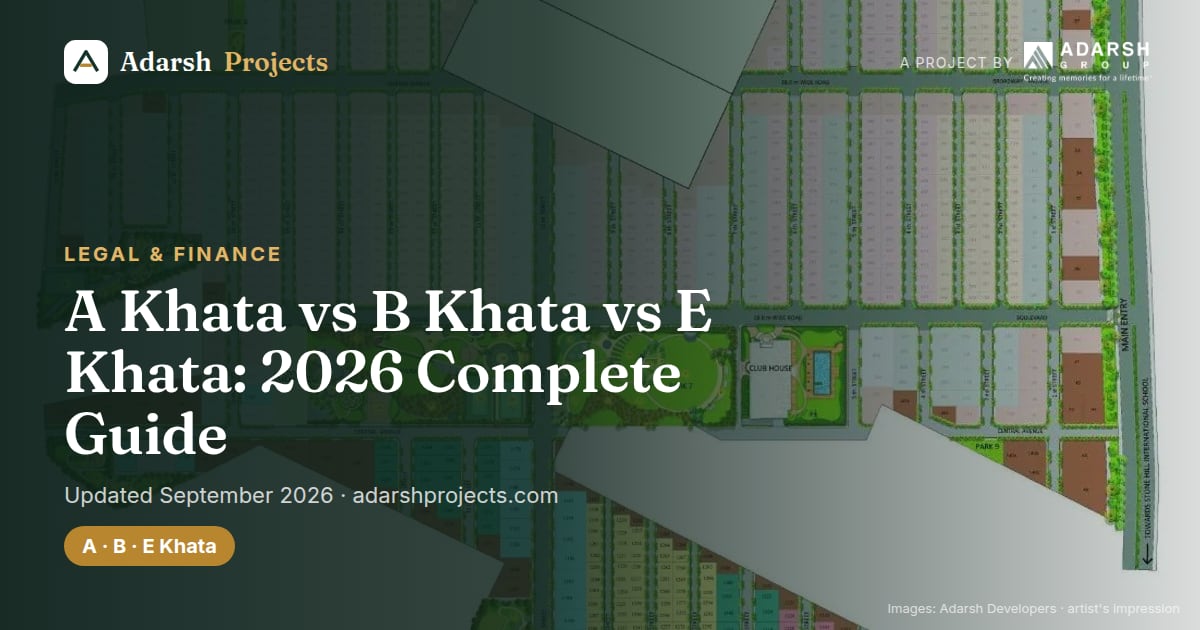
Our guide to A khata vs B khata vs e-khata explains each status in detail.
9. Property Tax Receipts
What it is. These receipts show that the owner paid property tax. Unpaid tax passes to you when you buy.
Where to get it. Ask the seller for the last three to five years of receipts. Check the dues on the city or panchayat portal.
Red flags:
- Missing years.
- Tax paid under a different name.
- Tax paid for a smaller site than the one you are buying.
- Tax paid only days before the sale, for many years at once.
A late bulk payment is not illegal. It can hint that the seller wants to hide a past issue, though. Ask why.
10. K-RERA Registration
What it is. The Real Estate (Regulation and Development) Act, 2016 protects buyers in new projects. Under Section 3(2)(a), a project must register if its land exceeds 500 square metres or it has more than eight units. Most new plotted layouts cross that line.
Where to get it. Search by project name on rera.karnataka.gov.in. Download the approval, the layout plan and the quarterly updates.
What to match:
- Project name and developer name
- Survey numbers
- Number of plots
- Completion date
- Bank account for buyer payments
Red flags:
- No RERA number for a large layout.
- A RERA number for a different phase.
- A lapsed registration.
- Complaints listed against the developer.
Also check the agreement for sale. RERA rules limit how much a developer can take before signing it. Read the refund and delay clauses.
For a worked example, see the legal section of Adarsh Savana Phase 3. Then check the number on the K-RERA site yourself.
11. Survey Sketch
What it is. A survey sketch shows the shape and boundaries of the land. Survey staff draw it for a survey number or a sub-division. Records like the "11E sketch" or "podi" records help confirm splits in the land.
Where to get it. Apply through the survey office or Bhoomi services. For a layout plot, also ask for the layout sketch that marks your plot.
Red flags:
- The plot on the ground differs from the sketch.
- A neighbour's fence cuts into the plot.
- A road on the sketch does not exist on site.
- The sketch shows a lake, drain or channel near the plot.
Visit the plot with the sketch in hand. Walk the edges. Check the four boundary stones. You can plan a site visit with our team and bring the sketch.
12. Road and Park Handover Deed
What it is. When a layout gets approval, the developer usually hands roads, parks and civic amenity sites to the local body. This deed is often called a relinquishment deed. It proves the common areas belong to the public.
Where to get it. Ask the developer. Check the registration at the sub-registrar office.
Red flags:
- No deed at all.
- Roads still in the name of the landowner.
- Park land later shown as extra plots for sale.
Without this deed, a landowner could later block a road. That hurts your access and your resale.
13. Development Agreement or GPA
What it is. Many developers do not own the land. They sign a joint development agreement (JDA) with the landowner. They may also hold a general power of attorney (GPA) to sell the plots.
Where to get it. Ask the developer for the registered JDA and GPA.
What to check:
- Both documents are registered.
- The survey numbers match the layout.
- The GPA allows the developer to sell plots.
- The landowner has signed the sharing of plots.
- The GPA has not been cancelled.
Red flags:
- An unregistered JDA.
- A GPA from only some of the landowners.
- A dispute between the landowner and the developer.
If a landowner cancels the GPA, your sale can stall. Your lawyer should confirm it is still valid on the day you register. Compare what the developer shares with the K-RERA details on the project page.
14. Acquisition Check
What it is. Government bodies can take land for roads, rail lines, industrial areas or new layouts. If your plot falls in such a plan, you could lose it.
Where to check:
- BDA for city layouts and ring roads
- KIADB for industrial areas
- The planning body's master plan for road widening
- National and state highway notices
- The RTC for any acquisition note
Red flags:
- A preliminary or final acquisition notice on the survey number.
- A planned road through or next to the plot.
- A seller price far below nearby plots with no clear reason.
Get the master plan and the zoning map. Check the land use for your plot. It should read "residential".
Documents Your Bank Will Ask For
If you plan to take a loan, your bank will run its own legal check. It usually asks for:
- Title deed and title chain
- EC for a set number of years
- Khata or e-khata and tax receipts
- Conversion order
- Layout approval and release letter
- RERA registration, for a new project
- Agreement for sale
A bank's approval is a useful second check. It does not replace your own lawyer, though. Banks protect their loan, not your interests. Our plot loan vs home loan guide explains what banks fund.
Your Step-by-Step Checking Order
Check in this order. It saves time because early checks can end the deal.
- Ask for the full document set. A good seller gives it without delay.
- Run the free online checks. RTC, EC, khata and RERA take under an hour.
- Check the conversion and layout approval. Most problems show up here.
- Visit the site with the sketch. Match the plot on the ground.
- Hire a lawyer for a title report. Share every document.
- Get the bank's legal approval. Do this before you pay a large sum.
- Take a fresh EC. Do this a day or two before registration.
What a Property Lawyer Charges and Delivers
Fees vary by lawyer and by the number of documents. Ask for a quote in advance.
A good title report should cover:
- The full title chain and any gaps
- The status of every approval
- Any loans, cases or claims
- A clear yes or no on whether you should buy
- A list of documents to collect at registration
Ask for the report in writing. A verbal "all is fine" does not protect you.
Honest Limits of This Checklist
This list covers the common checks. It cannot cover every case.
- Online records sometimes lag behind the office records.
- Court cases do not always show up on land portals.
- Old family disputes may not appear in any record.
- Rules on conversion and khata changed in 2025 and 2026, and may change again.
That is why a lawyer's report and a site visit both matter.
Where to Start Your Plot Search
Start with layouts that already hold a RERA number and a planning approval. You can browse options on our plots in Bangalore page.
If you are weighing a plot against a flat, read our plot vs apartment guide. For the airport corridor, the Devanahalli investment guide covers the local market.
Adarsh Savana Phase 3 is a plotted development in Devanahalli. Ask for its full document set and run all 14 checks. When you are ready, book a site visit and carry this list with you.
Sources
- Kaveri 2.0 — Karnataka Stamps and Registration (EC, deed copies)
- Bhoomi — Karnataka land records (RTC, mutation)
- Karnataka land conversion portal
- K-RERA project search
- GBA e-Aasthi portal (e-khata)
- e-Swathu (rural property records)
- Real Estate (Regulation and Development) Act, 2016 — full text, Section 3(2)(a) (Kerala RERA, Government of Kerala)
- Deccan Herald — Karnataka notifies Land Revenue (Amendment) Rules to ease non-farm use of farmland (24 December 2025)
- Deccan Herald — Land conversion under Section 95 of the Karnataka Land Revenue Act (30 April 2022)
Frequently asked questions
What documents should I check before buying a plot in Bangalore?
Check the title deed, mother deed, encumbrance certificate, RTC, mutation record, conversion order, layout approval and khata. Also check tax receipts, K-RERA registration, survey sketch, road handover deed, any development agreement and acquisition status.
How many years of encumbrance certificate should I check?
There is no single rule. Your lawyer and your bank each set the period they need, so ask both. A longer period gives you a better view of past loans and sales.
Can I verify a plot's documents online in Karnataka?
Yes, for most of them. Use Kaveri 2.0 for the EC and deeds, Bhoomi for the RTC and mutation, and e-Aasthi or e-Swathu for the khata. Use the K-RERA site for project registration.
Is RERA registration needed for a plotted layout?
Yes, in most cases. Section 3(2)(a) of the RERA Act exempts only projects up to 500 square metres or up to eight units, across all phases. Check the number on the K-RERA site.
What is a DC conversion order?
It is an order that lets farm land be used for homes or other non-farm use. It comes under Section 95 of the Karnataka Land Revenue Act. Without it, you cannot legally build on the land in most cases.
Do I need a lawyer if I check the documents myself?
Yes. Online checks catch obvious problems. A property lawyer reads the full title chain and spots issues that a portal will not show. The fee is small next to the price of a plot.
Adarsh Projects Research Desk
Channel-partner research team · Last reviewed 15 Sept 2026
We track K-RERA filings, price sheets and site progress for every Adarsh project in Bengaluru.
This guide is general information, not legal, tax or investment advice. Prices marked * are indicative as of September 2026.